Coronet
Mariners' Museum, Uncurated Search Results
Type: Bugeye
Year: 1888
Builder: J. Branford
Location: Fishing Island

These records are found in the online catalog of The Mariners’ Museum and Park in Newport News, Virginia. Uncurated search results are presented to give researchers and interested readers an idea of whether the museum’s archives contain information about this vessel and whether it may be worthwhile to visit the museum’s catalog search page for further investigation. Uncurated results may be inaccurate or incomplete.
Search mode: Exact Name. Search phrase(s): "Coronet". Results returned: 30. Results displayed in this table: 30.
Use these buttons to send uncurated search results to your own app or text document for further research. First, check the box for any row, or click "Select All" then uncheck any rows. Then click "Show Selections". You can then copy your selections from the text box and past them into your app.
| Fetch? | Row ID | Media | Date | Vessel | Place | Related Places | Inscription/Marks | Subject | Notes | Archive Number |
|---|---|---|---|---|---|---|---|---|---|---|
| 1 | No image URL. | Coronet | P0001.011/01-0706 | |||||||
| 2 | No image URL. | Schooner yacht Coronet. | LB91758 | |||||||
| 3 | No image URL. | Coronet (Schooner-yacht) | Voyages and travels.; Yachts. | Coronet memories : __log of schooner-yacht Coronet on her off-shore cruises from 1893-1899 | LB9973 | |||||
| 4 | No image URL. | Shipwrecks–North Atlantic Ocean. | Tragic voyage of the Shiloh schooner Coronet. | LB48126 | ||||||
| 5 | 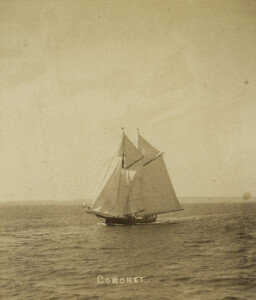 | 1887 | handwritten on image: Coronet. | Port bow view of Coronet during the Ocean Race from New York to Queenstown. This is one of six small photographs on page 26. | MS0267/-01#26-B | |||||
| 6 | No image URL. | Yachts.; Schooners. | Progress slow but steady on Victorian yacht Coronet. | LB88686 | ||||||
| 7 | No image URL. | Japan–Description and travel. | Solar eclipses–1896; United States Naval Expedition to Japan, 1852-1854 | Corona and Coronet : __being a narrative of the Amherst eclipse expedition to Japan, in Mr. James's schooner-yacht Coronet, to observe the sun's total obscuration, 9th August, 1896 __by Mabel Loomis Todd | LB9974 | |||||
| 8 | 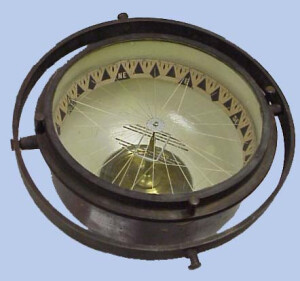 | SHORT DESCRIPTION: (Morzer Bruyns, 1995) Compass, Sir William Thomson design, and "Gillie's Patent Coronet Card", made by WILSON & GILLIE of North Shields, England. Brass bowl with weight and glass lid and gimbal. The card, with six needles, is graduated 0°-90° in 1° and 128 points. TIME-SPACE: 1890-1910. ADDITIONAL INFORMATION: SEE COLLECTION FILE. THIS PATENT CARD IS NOT MENTIONED IN A.E. FANNING, STEADY AS SHE GOES. LONDON, 1986. | CL9335 | |||||||
| 9 | No image URL. | Coronet (Yacht) | Hawaii–Description and travel.; Japan–Description and travel. | Voyages and travels. | Cruise of yacht "Coronet" to Hawaiian Islands and Japan __letters of H.P.J | LB1869 | ||||
| 10 | 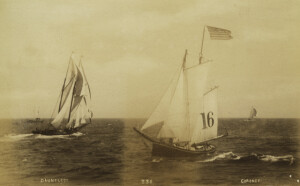 | handwritten on image: Dauntless. 336. Coronet. J.S. Johnston, View & Marine Photo, N.Y. | Dauntless and Pilot Boat #16 are pictured in the foreground. Coronet can be seen in the distance. | MS0267/-01#27-B | ||||||
| 11 | 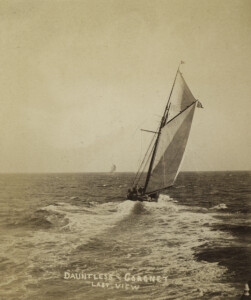 | 1887 | handwritten on image: Dauntless & Coronet. Last View. | View of Dauntless and Coronet during the Ocean Race from New York to Queenstown. This is one of six small photographs on page 26. | MS0267/-01#26-A | |||||
| 12 | No image URL. | Submarines (Ships)–History. | Caption title. Negative photocopy. Offprint: Coronet. Jan. 1937. | LB38884 | ||||||
| 13 | 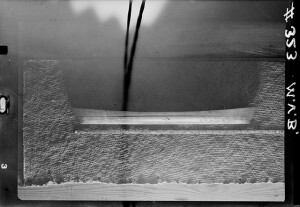 | Envelope: "Bugeye Coronet. 'B' Leas, Half model" Negative: "#323 M.V.B." | Ship models–United States.; Sailboats–Models. | Shows the hull of a model boat, it is set on a cloth on a table to be shot. This shot is similar to 0321. | MS0063/01-323#0323 | |||||
| 14 | 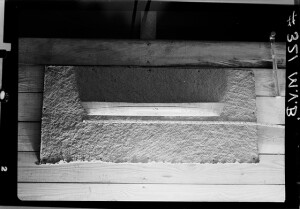 | Envelope: "Bugeye Coronet. Half model" Negative: "#321 M.V.B." | Ship models–United States.; Sailboats–Models. | Shows the hull of a model boat, it is set on a cloth on a table to be shot. | MS0063/01-321#0321 | |||||
| 15 | 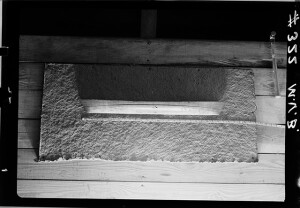 | Envelope: "Bugeye Coronet. Half model. K 1 1/2" Negative: "#322 M.V.B." | Ship models–United States.; Sailboats–Models. | Shows the hull of a model boat, it is set on a cloth on a table to be shot. This shot is similar to 0321. | MS0063/01-322#0322 | |||||
| 16 | No image URL. | Coronet (Schooner : 1885). | 20+ | LB48125 | ||||||
| 17 | No image URL. | Silversides (Submarine) | World War, 1939-1945–Naval operations–Submarine. | Cover title. Detached from: Coronet. (Nov. 1945). Condensed from the book Silversides, published by Henry Holt and Company, Inc., New York, N.Y.; c1945. | LB34333 | |||||
| 18 | 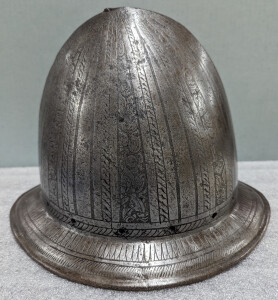 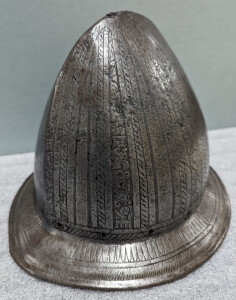 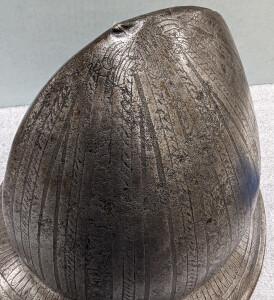 | SHORT DESCRIPTION: An Italian 'Spanish morion' or 'cabasset' of one piece of metal, with tall pointed skull with a spur at the apex. A row of rivet holes encircles the brim. The brim is narrow and flat, stamped with a mark (a shield with three figures with a crown over top), and with a rolled roped edge. The helmet is etched overall in the "Pisan" manner with bands and borders of trophies and involving a shield of arms under a coronet at the front. The front of the helmet is decorated with a crest under a coronet. It has been suggested that the crest is over the Barberini family, but a search online shows that the Barberini family crest has three bees on the shield not two lions passant (walking with right front paw raised and the others on the ground). NOTES: According to Alain Outlaw in the publication "Governor's Land, Archaeology of Early Seventeenth-Century Virginia Settlements", Department of Historic Resources, University Press of Virginia, 1990, page 133, Cabasset helmets were worn by foot soldiers in the second half of the sixteenth century and throughout the seventeenth century. The word cabasset means "pear" in Italian the small point of the helmet is supposed to represent the stem. [J. Willoz-Egnor, 4/11/2024] According to 'The Complete Encyclopedia of Arms & Weapons' edited by Leonid Tarassuk and Claude Blair, the word cabasset is an alternative term for a Spanish morion. A morion was a helmet mainly used in the 16th century by light cavalry and infantry soldiers, particularly muskateers and archers. In better-made and more expensive morions, the skull, comb, and brims were made of one plate. The Spanish morion had a pear-shaped skull, often with a backward-pointed "spur" on the apex. A row of rivets along the brims attached triangular laminated cheekpieces and an internal band of leather, to which the lining was stitched. The rivet heads were often embellished with decorative chiseled rosettes in iron or brass. Parade morions, including the helmets of palace guards, were richly ornamented with embossing or etching, those made for purely military use were usually quite plain. According to 'A Historical Guide to Arms & Armor by Stephen Bull the cabasset was usually narrow-brimmed and tall, slightly flattened in section and increasingly common from the mid sixteenth century. Some examples have a stalk-like protrusion on top, and it has been suggested, perhaps erroneously, that the name 'cabasset' is from an Italian word for 'pear', hence the description 'pear-stalk cabasset'. Another derivation says that this helmet is really a form of 'Spanish morion' and that the name is anglicized from a Spanish word for 'helmet'. The popular term 'morion' is normally applied to the comb morion--open faced, with the brim forming high peaks front and back and a raised comb. It was a common pikeman's headgear over much of Europe, including France and Germany from mid-century. It was popular in decorated form, for royal and municiple guards. | CL23470 | |||||||
| 19 | 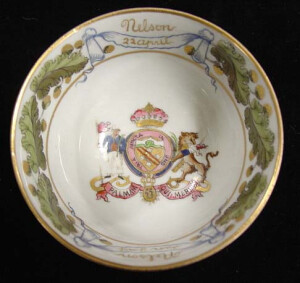 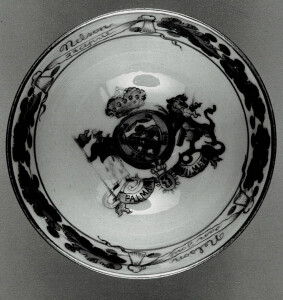 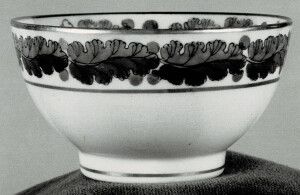 | SHORT DESCRIPTION: Small tea bowl without a handle, a later copy of the oak leaf service pattern associated with Vice-Admiral Horatio Nelson (1758-1805). Painted inside with his coat of arms within the motto 'TRIA JUNCTA IN UNO' (three joined in one), his personal motto inscribed incorrectly on a ribbon below 'PALMAM OUT MERUIT FERAT'. It is surmounted by his Viscount's coronet but not his crests. There is a border inside and out of oak leaves and acorns within gold bands. Within the inside border there are two blue swags inscribed 'Nelson', 'San Josef' and 'Nelson', '22 April' (the date of the battle of Copenhagen 2 April). NOTES: [J. Sands, 1984] This bowl is Chinese, and is similar to one made by Sanson of Paris in the McCarthy Collection at Portsmouth. The Chinese bowls which include a much larger punch bowl once owned by Mrs. McCarthy, are dated 22 April, which is erroneous. The Samson bowl corrects the date to 2 April. NOTES: Legend "TRIA JUNCTA IN UNO" (three united as one) refers to Nelson's relationship with Sir William and Lady Hamilton. When he became Knight of the Bath, after the Battle of Cape Saint Vincent, Nelson designed his coat of arms. Included were a sailor trampling and the British lion tearing the Spanish flag, and SAN JOSEF, captured by Nelson during the battle. At the Battle of Cape St. Vincent, February 14, 1797, Nelson in the HMS CAPTAIN captured the larger Spanish warship SAN JOSEF. | CL4891 | |||||||
| 20 | 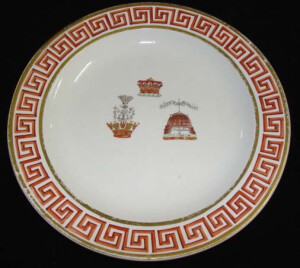 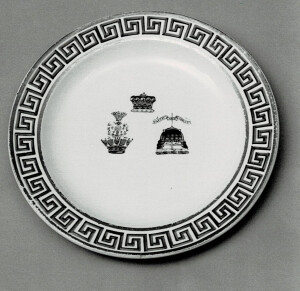 | SHORT DESCRIPTION: Neale creamware plate with red Greek key border and gold banding. Painted with the Nelson crest. Centered at top, earl's coronet for William, first Earl Nelson, to the left is a crown topped with the Chelengk,to the right the stern of a ship marked St. Josef (San Josef), from the mast, a ribbon printed with Faith and Works. Made by Wilson of Hanley. Dates before 1817 when the firm was closed. NOTES: Plate from the Reverend William Nelson (1757-1835) service. The reverend became the 2nd Baron Nelson of the Nile and Hillborough (County of Norfolk) and the Sicilian 2nd Duke of Bronte on the date of his brother's death. On the 20th November 1805 he was created Earl Nelson and Viscount Merton (of Trafalgar and Merton in the County of Surrey). NOTES: Comments from Bonhams 2024 auction Nelson Forever!: The Reverend William Nelson appears to have commissioned an extensive service to celebrate his inherited title of 1st Earl Nelson. In contrast to the bright Japan pattern chosen by his late brother and Emma, William elected for a set with a simple classical keyfret border in red and gold. Two principal sets of this pattern were made for William Nelson. One was a tea set using Coalport porcelain, the other a breakfast and supper service in creamware, some pieces bearing the impressed mark of Wilson. Both sets will have been decorated outside of the manufactories. The creamware breakfast service passed to Earl Nelson's daughter, Charlotte, and part of this was included as lot 41 in Viscount Bridport's sale at Christie's in 1895. | CL6853 | |||||||
| 21 | 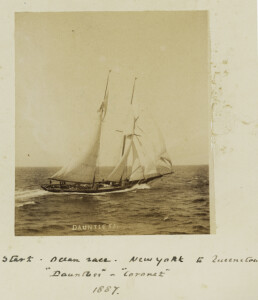 | 1887 | handwritten on image: Start. Ocean Race. New York to Queenstown. Dauntless & Coronet.1887. | View of Dauntless during the Ocean Race from New York to Queenstown. This is one of six small photographs on page 26. | MS0267/-01#26-E | |||||
| 22 | 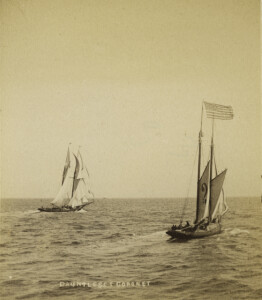 | 1887 | handwritten on image: Dauntless & Coronet. | Stern views of Dauntless and Pilot Boat #2 under sail during the Ocean Race from New York to Queenstown. This is one of six small photographs on page 26. | MS0267/-01#26-C | |||||
| 23 | No image URL. | SHORT DESCRIPTION: British Silver Medal for the Second New Zealand War. The obverse contains the Queen's bust, wearing a diadem and veil. The medal is fitted with an ornamental bar for suspension by a ribbon: dark blue with a broad crimson strip down the center. The reverse contains the dates 1860-to 1861 in laurel and oak wreath with the legend NEW ZEALAND, VIRTUTIS HONOR. ADDITIONAL INFORMATION: See "Naval Medals," Vol. I, p. 327-28. NOTES: From "War Medals and Their History", by William Augustus Steward: The New Zealand Medal.—This, the second in the chronological order of the series facing page 188, was granted to the troops and seamen who had taken part in the Maori Wars of 1845-6-7 and 1860-1-2-3-4-5-6. The medal, however, was not authorised by a general order until 1869, and there are twenty-two different dates for the army and ten for the navy in raised letters in the centre of a laurel wreath, above which, following the outline of the medal, is "New Zealand" and below "Virtutis Honor." On the obverse is the bust of Queen Victoria with a coronet, in which fleur de-lis stand out prominently, holding a veil which falls upon the shoulders, and the legend "Victoria D. G. Britt. Reg. F. D." The suspender is fashioned after the manner of a fern frond. This type is only seen with this medal, which is 1-2/5" in diameter. No bars were issued, but the dates of service were struck as stated above, for example: 1845-7,1860, or 1860-6; the rank, name, and ship or regiment being impressed on the edge. The medallists were Joseph S. and Alfred B. Wyon, but their names are not always found on truncation of the bust on the obverse of the medals. The ribbon, 1-1/4" wide, is dark blue with dark-red centre of equal width to the blue which borders it. | CL4293 | |||||||
| 24 | No image URL. | Porthole murder case : the death of Gay Gibson. | LB96114 | |||||||
| 25 | 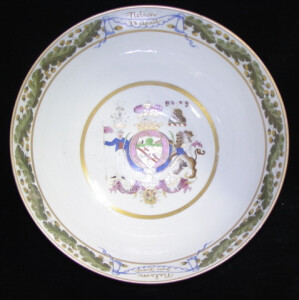 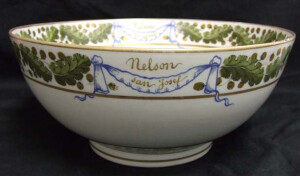 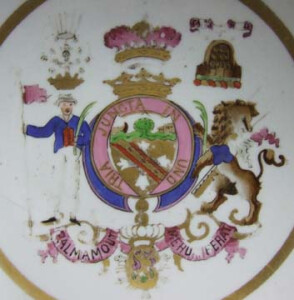 | SHORT DESCRIPTION: Large bowl, a later copy of the oak leaf service pattern associated with Vice-Admiral Horatio Nelson (1758-1805). Painted inside with his coat of arms within the motto 'TRIA JUNCTA IN UNO' (three joined in one), his personal motto inscribed incorrectly on a ribbon below 'PALMAM OUT MERUIT FERAT'. It is surmounted by his Viscount's coronet but not his crests. There is a border inside and out of oak leaves and acorns within gold bands. Within the inside border there are two blue swags inscribed 'Nelson', 'San Josef' and 'Nelson', '22 April' (the date of the battle of Copenhagen 2 April). Some wear to applied decoration, but bowl is in good condition. NOTES: Legend "TRIA JUNGTA IN UNO" (three united as one) refers to Nelson's relationship with Sir William and Lady Hamilton. At the Battle of Cape St. Vincent, February 14th 1797, Nelson in the HMS CAPTAIN captured the larger Spanish warship SAN JOSEF. According to Lily Lambert McCarthy in her book "Remembering Nelson" the date on the bowl is incorrect (it should read 2 April) and commemorates the Battle of Copenhagen. | CL23275 | |||||||
| 26 | 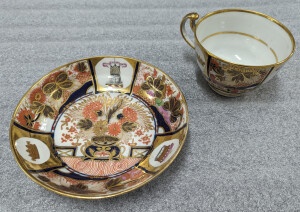 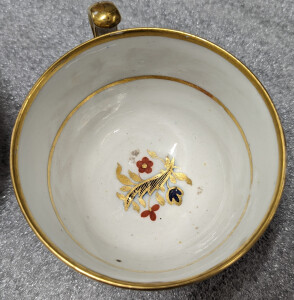 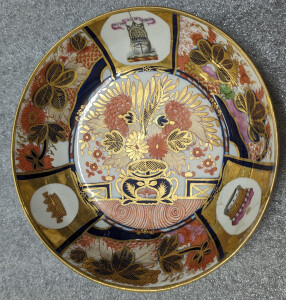 | SHORT DESCRIPTION: Soft paste porcelain cup and saucer made by the Chamberlain factory of Royal Worcester sometime between 1802 and 1805 for Vice Admiral Horatio Lord Nelson. It was part of a breakfast service sometimes referred to as the 'Horatia' service. The cup and saucer are in Chamberlain's 'Fine Old Japan' pattern (number 240) with the addition of Nelson's heraldic/armorial devices. Hand painted in rich Imari colors and gold, with the Imari style floral decoration overall including pairs of green quail, alternating with gold-ground panels painted with a Naval Crown, a viscount’s coronet, and the stern of the San Josef crest with Nelson's family motto 'Faith and Works'. A bowl of flowers is in the center of the saucer. The saucer has been broken and repaired at some point long past. NOTES: Information published on the website of the Museum of Royal Worcester regarding this china: In 1802 Admiral Lord Nelson and his mistress Emma Hamilton visited the Chamberlain factory and ordered an extravagant breakfast (148 pieces), dinner (never made), and dessert service. Large services with elaborate decoration took several years to produce as everything was done by hand. Only this breakfast service was completed before Nelson's death at Trafalgar in October of 1805. One of the most famous visits to Royal Worcester must be the Lord Nelson visit in the late summer of 1802. Taking advantage of the brief pause in the wars with France, Admiral Nelson took a tour of Wales and the West Country with his mistress Emma Hamilton and her husband Sir William Hamilton. On Sunday 26th August they arrived in Worcester where they were warmly received by crowds. They visited Mr. Chamberlain’s china shop at 33 High Street, opposite the Guildhall. Nelson was full of admiration and placed a large order for a breakfast, dinner and dessert service to be decorated in the Fine Old Japan pattern, number 240 ‘with the arms of several orders conferred’, two vases, two cups and saucers and an inkstand, to be sent to ‘No 23 Piccadilly, opposite the Green Park’. This ‘Fine Old Japan’ pattern refers to this sumptuous Imari style of decoration with blue, red and other bright colours and rich gilding and required much laborious hand-painting. It is notable that Nelson asked for his full coat of arms to be painted on the service as he had recently been elevated to the peerage and made Viscount Nelson and so given the right to display his arms which feature references to his military victories and bravery. Three years later, when Nelson died at Trafalgar (21 October 1805), Chamberlain had only delivered part of the order. Nelson left the breakfast service in his will to his beloved Emma Hamilton. It must have been a blow to her to receive the bill from Chamberlains for the breakfast service, plus four 10-inch dishes and one 12-inch dish at a total cost of 120 pounds 10 shillings and sixpence, only one week after Nelson’s state funeral in January 1806. NOTES: Emma Hamilton's extravagant lifestyle soon expended her fortune and the breakfast service was dispersed. Only eight cup and saucer sets are known. One cup and saucer set are in the collection of the Victoria & Albert Museum. Other pieces including teacup and saucer are at the National Maritime Museum, Greenwich. | CL22023 | |||||||
| 27 | No image URL. | NOTES: Henry Meyer was born in London in 1783 and died there in 1847. | CL19165 | |||||||
| 28 | 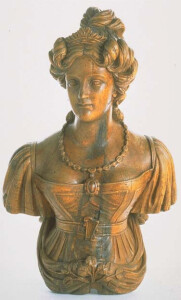 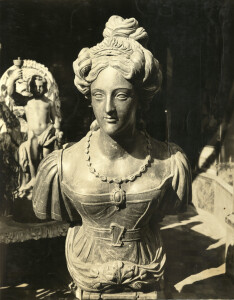 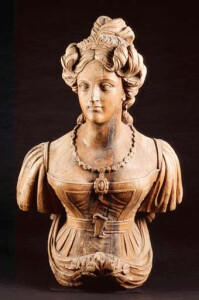 | SHORT DESCRIPTION: Half length female figure in early nineteenth century costume and wearing a small tiara with a small harp emblem at the waist. NOTES: [Carol Olsen, 1983] This figurehead has long been called "Irish Queen" because of the shamrocks at the base drapery and the harp at her waistband. However, she may not have anything to do with Ireland. Major sources in Ireland have mixed reactions to her which vary from "Those aren't shamrocks, and the harp could represent Wales", to "I think she personifies Ireland." Our evidence about her is too slight to identify her as Irish Queen in a label, but I refer to her that way for convenience. I wrote to various authorities in Ireland asking their opinions about the identify of this figurehead. Their responses ranged from 1) personification of Ireland, 2) possibly the pirate queen Grainne O'Malley, or 3) they have no idea. Cork Historical & Archaeological Society: Possibly Hibernia (Ireland) or Grainne O'Malley; Royal Society of Antiquaries of Ireland: Suggests date of 1810; suggests stylistic influence of the Royal Hibernian Academy sculptors, in particular Edward Smyth, suggests likely to represent Hibernia and think the quality is exceptionally fine for a ship figurehead; National Museum of Ireland: Perhaps Grainne O'Malley, think the shamrocks are only leaves (however they look like the shamrocks depicted in Webster's dictionary, the harp could represent Wales. Trinity College Library: No one could come up with an answer but it could be Grainne O'Malley or Queen Maeve. Irish National Maritime Museum: Bears no resemblance to any known historical figure, but could be fanciful representation of Grainne O'Malley or Queen Maeve of 3rd to 4th century BC. Art History Department, University College Dublin: Question the proposition that the figurehead represents an Irish figure. Seems idealized like an allegorical figure, eg, Erin, rather than representing a person. If she does represent a particular figure, perhaps she is Queen Maeve or Grainne. University College, Galway: Nicholas Canny, Professor of History and Dean of the Faculty of Arts: I think the carving is intended as a representation of Ireland who was traditionally protrayed as a female figure who had suffered under the tyranny of English rule. This was a literary motif in Gaelic poetry throughout the 18th century, but with the onset of Catholic Emancipation in the 19th century, Hibernia was more frequently displayed in more placid terms. National Gallery of Ireland: Idealized and could personify Ireland National College of Art and Design: Looks 1790s per Neoclassical style of dress. Probably personification of Hibernia or Ireland. Head with blank eyes, straight nose is conventionally Neoclassical, as is the stylize coronet. The shamrocks are not really shamrocks but stylized plants, unlike the more naturalistic shamrocks of the Romantic period (1830s on). The harp is the classical orchestral harp, not the figured harp with its romantic overtones. It reflects international Neoclassical tendencies more than any local reference. Edward Smyth was a skilled Irish sculptor of the Neoclassical period who is known to have worked in wood. Olsen's conclusions based upon correspondence and research: 1) two sources mention Edward Smyth's work. Since he worked in wood we should try to find examples of his work. 2) Even though many correspondents mention her Grainne was a rough and tumble pirate which our figurehead clearly doesn't depict. Our carving is comparable to figureheads of the 1840s such as Dona Januaria. I don't think our figurehead is Grainne O'Malley. 3) Two sources say the figureheads shamrocks are not really shamrocks. Also, the harp on our carving appears to be in an area of repair, and just possibly it is not original. This could mean our figurehead has nothing to do with Ireland or Wales. On the other hand, a number of people seem willing to suggest that she could represent Hibernia (Ireland). 4) Having checked all the sources, we can at least be sure that our figurehead is not a famous Irish woman immediately recognizable in learned Irish circles. 5) I estimate a date of circa 1840 based on 1) her similarity to the Dona Januaria figurehead and 2) her similar posture to the 1837 figurehead Mary Hay. 6) I believe it to be from a vessel of perhaps 600 tons 7) it was probably carved in Europe (although note that Dona Januaria is said to have been carved in Brazil). Tentative conclusions about this figurehead are that she: -dates from circa 1840, - I expect her to be from a vessel of perhaps 600 tons, - probably has been carved in Europe. | CL3698 | |||||||
| 29 | 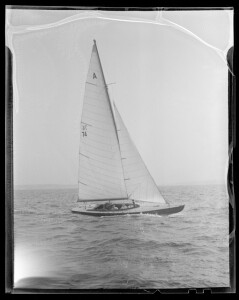 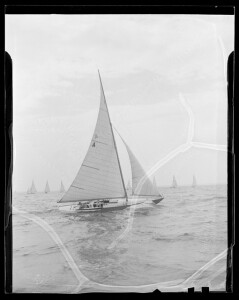 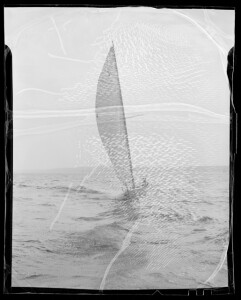 | Circa 1920 | New York Yacht Club–Photographs. | New York (N.Y.)–Photographs.; Newport (R.I.)–Photographs. | Yachts–Photographs.; Yacht clubs–Photographs.; Yachting–Photographs.; Yacht racing–Photographs.; Sailboats–Photographs.; Motorboats–Photographs.; Schooners–Photographs.; Sloops–Photographs.; Tugboats–Photographs. | Contains photographic negatives of the New York Yacht Club and the New York Yacht Club Cruise, the V class yacht Buddy, the V class yacht Bluejacket, the sloop Madame, the sloop Black Jack, the sloop Felicity, various unidentified sloops and yawls, the auxiliary schooner Delfin, the power yacht Yankee, the tugboat Samson, the auxiliary schooner Annette, the auxiliary schooner Black Arrow, the auxiliary ketch Billy II, the auxiliary schooner Carib, the auxiliary schooner Coronet, the power yacht Halaho, the auxiliary yawl Lady Lud, the auxiliary schooner Salee, the auxiliary schooner Tondeleyo, the auxiliary sloop Apache, the auxiliary sloop Constance, various unidentified Atlantic Coast class vessels, the beginning of the Atlantic Coast Class race, the auxiliary schooner Ladrone, the power yacht Charmarie, the power yacht Ellenar, the power yacht Sally III, the power yacht Aloha, the auxiliary schooner Antonia, the auxiliary yawl Alsumar, the auxiliary schooner Altura, the auxiliary schooner Altura II, the auxiliary schooner Bellatrix, the power ketch Bonnie Dundee, and the auxiliary schooner Carol. | P0002.001/50-023 | |||
| 30 | 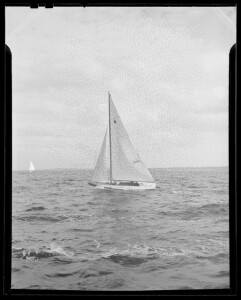 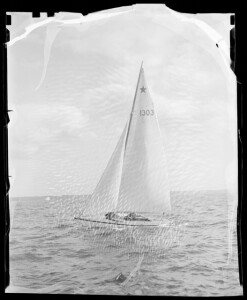 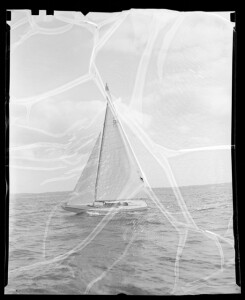 | Circa 1920 | New York Yacht Club–Photographs.; International Star Class Yacht Racing Association–Photographs. | New York (N.Y.)–Photographs.; Newport (R.I.)–Photographs. | Yachts–Photographs.; Yacht clubs–Photographs.; Yachting–Photographs.; Yacht racing–Photographs.; Sailboats–Photographs.; Schooners–Photographs.; Sloops–Photographs.; Motorboats–Photographs.; Tugboats–Photographs. | Contains photographic negatives of the New york Yacht Club and the New York Yacht Club Cruise, the star class yacht Themis III, various unidentified Star class vessels, the power yacht Amphitrite, the power yacht Maryann II, the power yacht Maryann, the power yacht Nicoya, the power yacht Sybarita, the power yacht Selkade II, the power yacht Tara, the power yacht Vinette, the auxiliary yawl Alsumar, the auxiliary yawl Pampero, the auxiliary ketch Sea Roamer, the auxiliary yawl Tautog, the auxiliary yawl Ariadne, the auxiliary schooner Bimesa II, the auxiliary schooner Coronet, the auxiliary schooner Coaster, the auxiliary schooner Countess, the auxiliary schooner Halcyon, the auxiliary schooner Teragram, the auxiliary schooner Tigress, the auxiliary schooner Voyager, the sloop Roulette, the power yacht North Star, the power yacht Power Star, the power yacht Semloh, the power yacht Vixen, the auxiliary yawl Capella, the auxiliary ketch Jesting, the auxiliary yawl Minstrel, the sloop Calypso, the tugboat Paul Card, the tugboat Comanche, the power yacht Restless, and various deck views of the vessel Dauntless. | P0002.001/50-025 |
Created 2026 by Don Barker, CBMM volunteer, for the Chesapeake Shipbuilding Project. shipbuilding@sailingworkboats.es